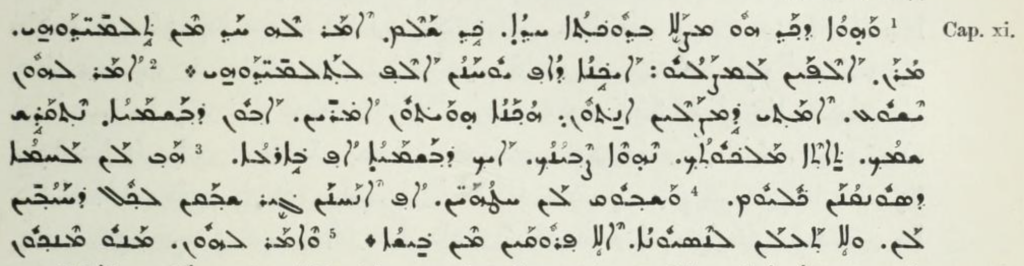
Here are the Gospel passages from Matthew 6:9–13 and Luke 11:2–4 regarding the Lord’s Prayer, based on a selection of ancient lectionaries in Aramaic and Aramaic-Syriac. As already noted in the article on the Lord’s Prayer, one can identify in these texts the passages corresponding to the petition for bread. The Greek text of Matthew 6:11 and Luke 11:3 speaks of epioúsios bread, which has often been translated as “daily bread.” However, the Greek word epioúsios has given rise to many different translations depending on the language, and some Church Fathers interpreted it as the bread pertaining to the ousía, the bread that bears the divine presence, the bread that came down from heaven, which is Christ himself. See the articles: Jerome on the Lord’s Prayer and Origen on the Lord’s Prayer, as well as John 6:22–59, “The Bread That Came Down from Heaven.”
The oldest translations of this word are those found in the Aramaic or Aramaic-Syriac lectionaries, that is, books used for the liturgy in the monasteries or churches of Palestine or in the more eastern regions where a form of Aramaic called Syriac was spoken. A Syriac version of the Bible, called the Peshitta, was in use in the Eastern churches.
Given that in Semitic languages the word for bread (leḥem, laḥm) denotes a substantial food—in Arabic, for example, laḥm is used for meat—here are the various terms used in Aramaic texts in place of epioúsios in the order of the manuscripts reproduced in this article:
1: amyno deyumo’: in which we trust or constant (amyno) of the day, of this day (deyumo) (in Matthew 6:11, Cureton)
amyno dekolyom: in which we trust or constant (amyno) of every day (dekolyom) (in Luke 11:3, Sinaitic Palimpsest)
The word amyno, twice. This term comes from the root aman (as in amen), and it expresses trust, faith in God: it is He who is faithful, trustworthy, and provides daily for the necessities of our life, both material and spiritual.
2: ‘atira, ‘atirin: rich, abundant (in Matthew 6:11 in two Aramaic lectionaries from St. Catherine’s Monastery on Mount Sinai and in the Evangeliarium Hierosolymitanus preserved in the Vatican. One could also imagine for this word the variant ‘atidin: that which is to come, that which is coming, that which is about to come)
The word ‘atirin, meaning “rich”: this refers to bread that is rich because it comes from God.
3. sunqonon: from the root snq, to need, to be necessary. This same word is also found in 1 Corinthians 12:22 to translate the Greek anankaîos, which means necessary (used in the Peshitta and present in the texts in use today in the Eastern Churches that have preserved the tradition of reciting the Lord’s Prayer in Aramaic).
The word sunqonon, “what we need,” also echoes the words Jesus spoke just before: “Your Father knows what you need before you ask him” (Matthew 6:8).
Here is also the Aramaic text of some other sentences of the Lord’s prayer whose translation from Greek was interpreted in different ways:
Corresponding to the Greek expression: “Lead us not into temptation (mē eisenénkēis hēmās),” in the oldest Aramaic versions and also in the Syriac version of the Peshitta, the Greek verb eisphérō, which means to introduce, lead toward or into, corresponds to the Aramaic forms t‘il and t‘l, factitive forms of the root ‘ll meaning to enter, and which therefore have the same meaning as in Greek: to cause to enter. In another ancient Syriac version of the Gospels (Cureton), the factitive form tyt of the verb ‘t’ (to come), which also means “to lead,” appears.
We can also observe in these texts the constant presence of the word nessayona when we ask not to be led into temptation (Matthew 6:13 and Luke 11:4). Through this Aramaic word, we can also see the close connection to the episode where the people in the desert rebelled against God and put him to the test: the place where this happened is called Massah (which comes from the verb, nassah) because the people tested God (in Hebrew, to test is precisely nassah). From this we can understand that the trial we must ask the Father not to let us experience is the loss of trust in divine assistance, in providence, which accompanies us throughout a life made up of trials: it is an invitation to live out filial trust to the very end, so that, with the help of the Father who accompanies and assists us, we may be victorious over evil.
Here below are the texts of the various manuscripts of the Lord’s prayer, along with their bibliographic references.
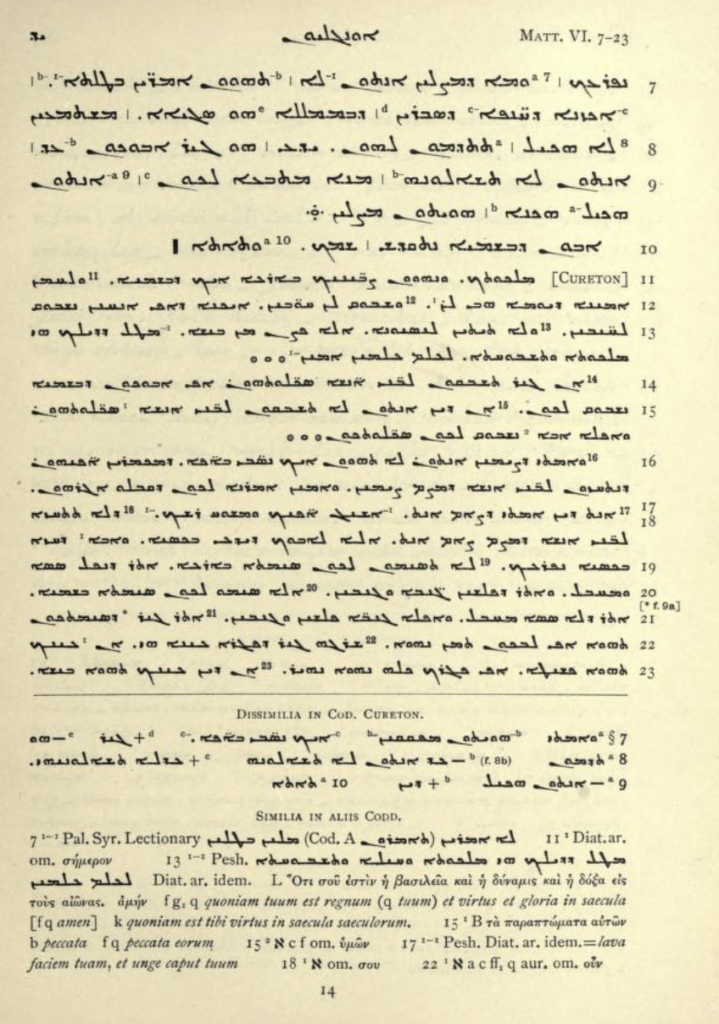
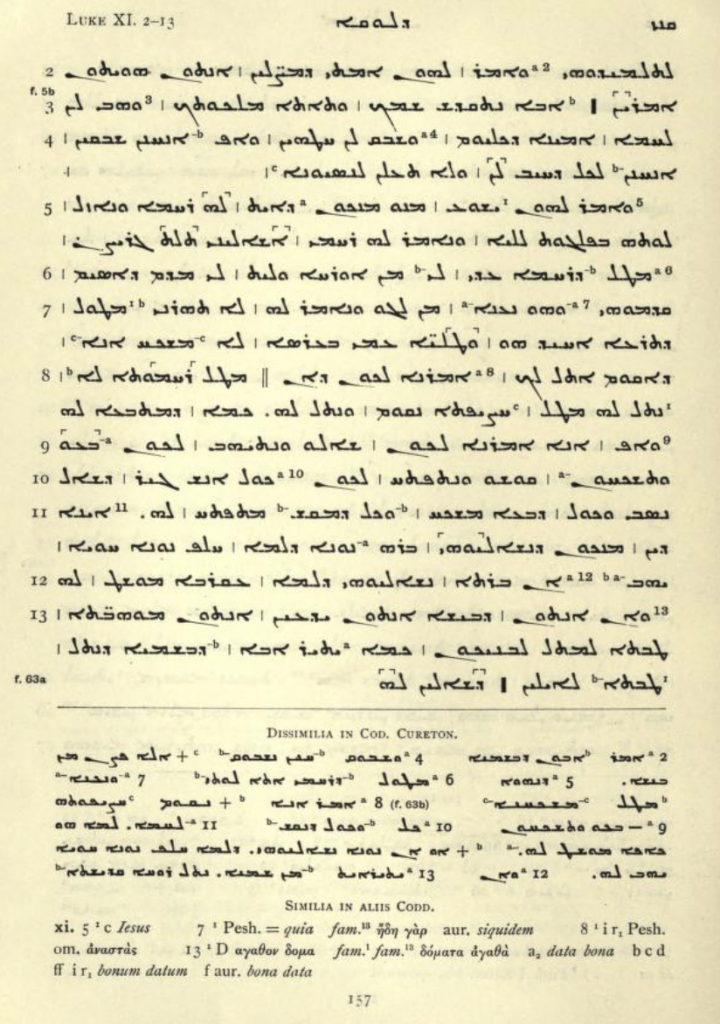
1. This Aramaic Gospel text reproduces that of the oldest manuscript found in this language at St. Catherine’s Monastery on Mount Sinai. It is a palimpsest, meaning a parchment on which the original writing was erased so that a new text could be written. The original text was nevertheless made legible through chemical techniques, acids, or sometimes ultraviolet light.
The Old Syriac Gospels or Evangelion da-Mepharreshe; being the text of the Sinai or Syro-Antiochene Palimpsest, including the latest additions and emendations. With the variants of the Curetonian text, corroborations from many other manuscripts, and a list of quotations from ancient authors, by Lewis, Agnes Smith, 1843–1926. Publication date 1910. University of California Libraries
On page 13, the text of Matthew 6:11–13 presents the text of the manuscript known as Cureton, since the pages of the Sinaitic Palimpsest are missing; this is a manuscript dating from the early fifth century and edited by F.C. Burkitt, Evangelion-Mepharreshe, Cambridge: University Press, 1904.
However, on page 157, the text of Luke 11:2–4 is transcribed from the Sinaitic Palimpsest, which is believed to be the text of the oldest Aramaic manuscript of the Gospel.
Here are the two passages of the Lord’s Prayer:
https://archive.org/details/oldsyriacgospels00lewirich/page/n415
https://archive.org/details/oldsyriacgospels00lewirich/page/n271
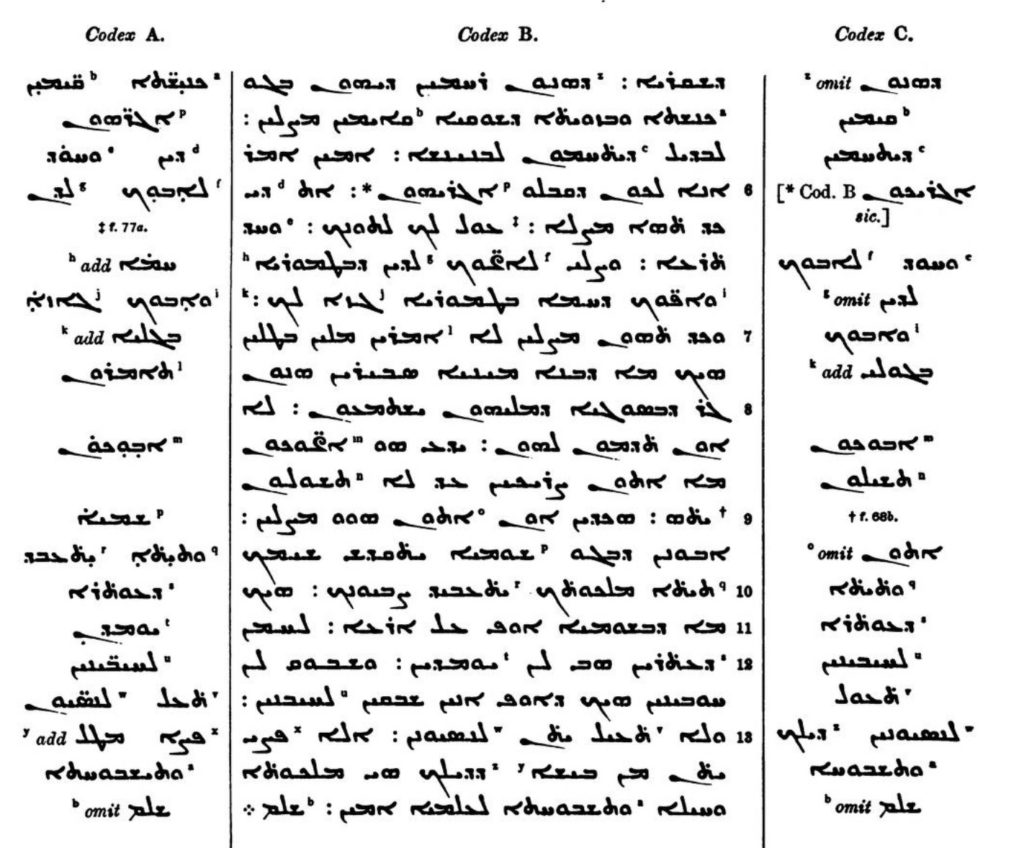
2. Here is the passage from Matthew 6:9–13 (Luke 9:2–4 is not preserved) as it appears in three ancient Aramaic lectionaries: Codex A, preserved in the Vatican (Evangeliarium Hierosolymitanus, circa 1030), and Codex B (circa 1104) and C (circa 1118), preserved in the library of the Convent of St. Catherine on Mount Sinai ( ). Although these manuscripts date from the 11th and 12th centuries, their significance lies in the fact that they were in use in Palestinian monasteries and are likely to be evidence of ancient versions used in Palestine, and thus represent an Aramaic closer to that spoken by the apostles.
The Palestinian Syriac Lectionary of the Gospels by Agnes Smith Lewis, Margaret Dunlop Gibson Publisher Kegan Paul, Trench, Trübner & Co, 1899
p.130
https://archive.org/details/palestiniansyri00gibsgoog/page/n139
3. Here are the texts of the Peshitta, the ancient version from the early fifth century used by churches of the Syriac tradition.
The New Testament in Syriac. Publication date 1905. Robarts – University of Toronto. London, Brit. and For. Bible Soc.
Here is the text of Matthew 6:9–13:
https://archive.org/details/newtestamentinsy00lond/page/n18
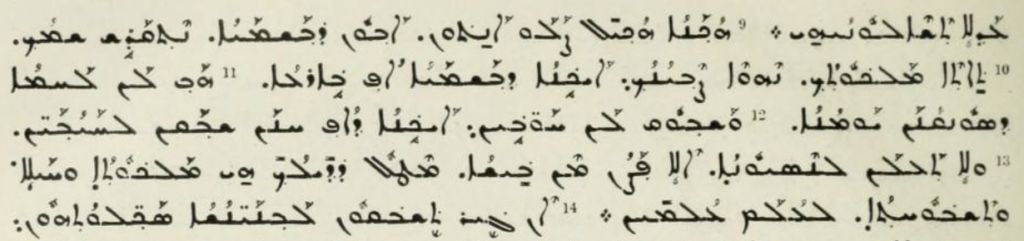
And here is Luke 9:2–4: